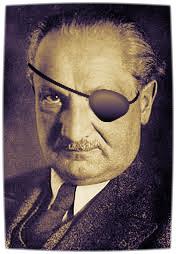
 Citation: Heidegger, Martin. "The Question Concerning Technology." Handout.
Response: As I read this essay, I couldn't help but be reminded of conversations from Dr. Enos's class on Classical Rhetoric. Since “truth” is no longer conceptualized as the Romans once did in saying “veritas,” Heidegger coins “revealing” to signify the nuanced construction of creating truth from our experiences of being, where “truth” is recognized as constructed by the community’s combining of perception with recognition and communication. “Being” occurs only through perception, and recognition, and associations, causations, etc. recognized by human participation. Connections/Questions: The instrumentality of Technology's essence necessarily involves a means and ends and describes the causation that occurs between the means and ends. This conceptualization of technology’s essence reminds me of Pierce’s thirdness in that the connection between the beginning recognition of a things essence and its realization in reality necessarily involves some form of causality. If considered in connection with Pierce’s taxonomy of being, Heidegger uses the process of questioning technology to question how “being” comes into existence. For him, it is not enough to simply say being exists and ask of what it is composed; we must understand how being is “revealed.” |
Citation: Cassirer, E. Language and Myth. Kindle Edition. Summary: Cassirer uses myth as a means of understanding the relationship of the word (all of symbolic expression) to the thought (conceptualization of being). Instead of thinking about language as a primary explanation of being through empirical reasoning or scientific language, the symbolic forms of language is a product of mythical ideation and represent our physical, perceptual relationship with experience. Mythical thinking dwells on the here and now of experience. In the same way, the word depends on the context of its interpretation (or what the Preface refers to as "pre-logic." Myth reveals how we identify language through experience and how the language in turn becomes a representation of that identification process. The impulse toward myth and the impulse toward language come from the same point of tension caused by the ambiguity of understanding in the parental force of consciousness (88).
Response: Similar to Pierce and Heidegger, Cassiere is concerned with the relationship of the conceptualization of being to its manifestation in symbolic expression. We have a way of understanding the world and then we meet something that causes us to question our understanding of the world. The back and forth caused by the tension of attempting to understand and realizing the experience cannot be fully understood seems to be the moment that Cassirer is trying to understand through mythical ideation. We had the idea before we tried to communicate it. We are never able to fully communicate the original concept through language (which could consume us in complete relativism and lead to total apathy), but the ideation of the myth saves us by returning the "magic" to the symbol. The desire to communicate the "mythos" of the experience saves us from feeling apathetic toward language. The word (discourse) is organic and living because it is a form of "being" birthed from the tension of consciousness. |

