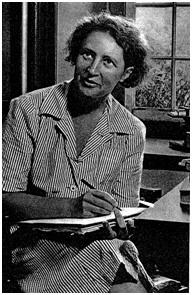
Citation: Langer, Susanne. Feeling and Form. Charles, Scribner's, & Sons: 1953.
Summary: Langer discusses art as a product of the studio, where expression arises from the context of the artwork (personal, physical, temporal, spatial) and all of the experiences surrounding the artist. A work of art does not simple express feeling; it expresses an idea of a feeling by presenting qualities that evoke similar experience within the viewer. In order to clearly describe the ways in which art evokes feeling, Langer discusses discursive and non-discursive symbols. Discursive language, such as English or Mathematics holds the purpose of eliminating ambiguity, while Non Discursive language dwells in a realm that allows for and takes advantage of ambiguity. Feeling and form define the non discursive nature of language, and when feeling is removed from language, the result is discursive thought.
Response:
On page 369, Langer's analogy of the shell: "...it can never be constructed by a process of synthesis, because no such elements exist outside it. They only occur in a total form; as the convex and concave surfaces of a shell may be noted as comprising its form, but a shell cannot be synthetically composed of "the concave" and the "convex." There are no such factors before there is a shell. Similarly, attempting to deconstruct the nature of language by focusing on the word as an expression OR, but not AND, as an impression leads to seeing the word one-dimensionally as so constructs an interpretation that is not true to the actual form. This theorizing of the word seems especially important in the here and now of composition studies. Comp teachers tend to stress either the social construction of knowledge in their classrooms or the individual's role in the creation of knowledge, but seldom both, and seldom both in paradox, allowing the students to battle through and arrive at their own interpretations. TCU's common 10803 syllabus uses assignments that I assume are meant to provide opportunities to think through these matters (the discovery essay and the personal essay) but often the students and teachers view the values of the personal essay and the values of the profile essay as antithetical, in some cases even questioning the role of the personal essay in the 10803 classroom.
Connections/Questions:
Langer's argument which takes on the paradox of expression and impression adds new dimension to my understanding of another article I read recently, "Audience Addressed/Audience Invoked..." by Lunsford and Ede. In order to provide the language necessary for discussing the dichotomy of pedagogies (one which perceives the author's role constructing writing that targets an already formed audience, and one which perceives the author's role as invoking an audience) Lunsford and Ede describe the two models as a paradox. While neither model represents a complete conception of the role of audience, the authors conclude with the suggestion that only by juxtaposing these two models of audience, can a more complete understanding of audience be accomplished. Similarly, Langer points out that the danger implicit in the paradox of expression v.s. impression, or considering "art" from a speaker-centric position verses spectator-centric position, is the tendency to develop systems that become antithetical to each other.
